Showing posts with label travel. Show all posts

Sunday, July 1, 2012

10,000 miles = 10,000 books in the Mongol Rally

10,000 miles = 10,000 books in the Mongol Rally:

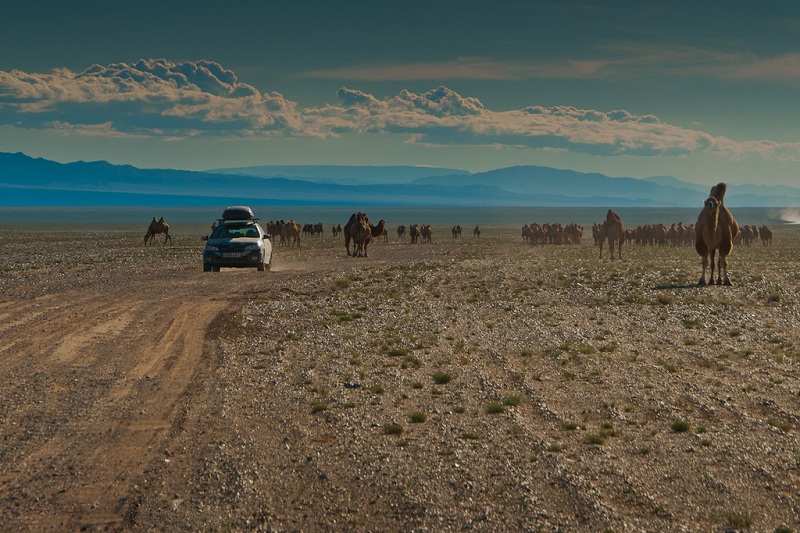
Mongolia Rally. Photo by: Leon Logothetis
Leon Logothetis will be covering this year’s Mongol Rally for Matador.
THE TRUTH IS, I probably shouldn’t be here. Events happened last year that conspired to nearly rob me of my life. Inches I tell you. Inches. Things happened. Bad things. I had signed up for the famed Mongol Rally; an arduous trek across 10,000 miles of desert, treacherous mountain ranges, and inhospitable territory. All attempted in a car that only your granny would be proud of.

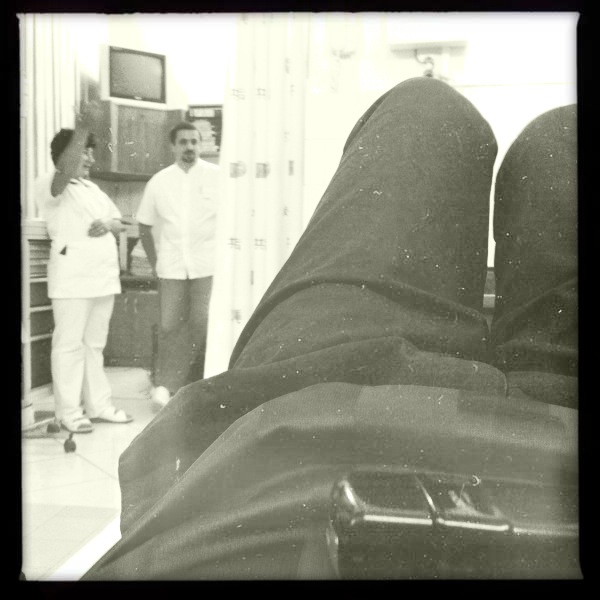
At the hospital. Photo by: Leon Logothetis
The aim was to drive from England to Mongolia. The reality was that I found myself lying on a hospital bed in a distant land. A broken collarbone and bruised ego in tow. Violent car crashes can do that to you. I never did reach Mongolia. My adventure ended on a Romanian road. My life, did not.
This year I’m trying again. Something inside just won’t give up. I guess I’m still chasing the sense of adventure lost on that dusty Romanian road. The sense of accomplishment. The daring. The cultures. The people. Life awaits. Adventure awaits. Mongolia awaits.
The 2012 Mongol Rally will see me visit 18 countries. Connect with hundreds of diverse people and drive thousands of miles. I’ve teamed up with Firstbook, and for every mile I drive I’ll be donating a book to an underprivileged child. Every mile is a book. Every book is a window into hope. Hope that a child will be inspired to live a full life. Hope that a child can grow up one day and yearn to see the world. Experiencing life. Experiencing adventure. Living outside of their box.

Rally car. Photo by Leon Logothetis
As I make my trek across a third of the world’s surface, I’ll be blogging and sending back videos daily. When (not if) I reach my destination of the Mongolian capital Ulaanbaatar, this man’s life will be changed for the better in some small way. And hopefully the 10,000 books will have a powerful effect on 10,000 kids. Here’s to hope, my friends.
You can follow my adventure starting July 14th here at Matador Network, on Facebook, and on Twitter.

Thursday, November 24, 2011

Lao Airlines connects S'pore to all ASEAN cities - TIME TO TRY

SINGAPORE: Singapore is now connected to all nine ASEAN city states with the arrival of Lao Airlines from Vientiane, the 11th new city link for Changi this year.

Lao Airlines will have thrice-weekly services between Singapore and Vientiane.

And its direct service comes on the back of strong bilateral ties between the two countries.

Singapore is among Laos' top 10 foreign investors, with investments in sectors ranging from manufacturing to hospitality.

In the first nine months of this year, bilateral trade saw a substantial growth of 40 per cent year-on-year to reach about US$29 million.

Singapore and Laos have also been regular cooperation and exchange partners since Laos joined ASEAN in 1997, across areas such as education, healthcare and tourism.

In a statement, Changi Airport said the number of passengers travelling between the two countries has grown steadily over the last five years.

During this period, Singapore visitor arrivals into Laos grew about 8 per cent annually to about 6,100 in 2010, while the number of visitors from Laos increased by some 25 per cent every year to about 5,200 last year.

- CNA/ck

Wednesday, August 3, 2011

Saudi tycoon to build world's tallest tower


RIYADH: Saudi billionaire Prince Alwaleed bin Talal launched on Tuesday a project to build the world's tallest tower at more than 1,000 metres in the Red Sea city of Jeddah.

The project to built a tower topping Dubai's world's highest building, Burj Khalifa, "will soon see the light after the signing of a $1.2 billion agreement" between Alwaleed's Kingdom Holding Co and construction giant Bin Laden Group, the Saudi tycoon told reporters.

It will take 36 months to build the tower, said the Saudi businessman, a nephew of King Abdullah and one of the kingdom's wealthiest men. He did not say when construction will begin.

Alwaleed said the tower was intended to "send a message of strength" reflecting the OPEC kingpin's economic and political stability.

"Our message is political," he said.

Saudi Arabia has been spared a wave of protests that has rocked the region, leading to the downfall of autocratic rulers in Tunisia and Egypt despite sporadic small protests staged by Shiites in the Eastern Province.

The tower, which will be part of a $20 billion project north of Jeddah, would top Dubai's 828-metre Burj Khalifa, which was opened last year.

It will include a hotel, apartments and offices occupying an area of
500,000 square metres.

- AFP/de

Kolkata - The 'second London' wannabe

KOLKATA, India - Kolkata, once capital of British India, on Tuesday began work to transform the congested and fading city into a "second London" complete with a London Eye ferris wheel.
Mamata Banerjee, the feisty new chief minister of the state of West Bengal, made an election pledge to turn the dysfunctional and poverty-stricken Indian metropolis into a world-class city.
The planned facelift marks the first major urban renewal effort in the state by Banerjee, who became known as "the giant killer" after she ended 34 years of uninterrupted Communist rule in West Bengal in May.
"My dream is to beautify the 10-kilometre riverfront of the city of Kolkata on the lines of London," Banerjee said as she laid the foundation stone of her project at the city's Millennium Park, on the banks of the river Hooghly.
"Never say no. Let us try for a better tomorrow for our city. The project will be green and environmentally-friendly," she said to hundreds of onlookers.

Kolkata, a bustling metropolis of 15 million people, whose name was officially changed from Calcutta in 2001, began as a cluster of villages on the eastern bank of the Hooghly River and grew into the capital of the British Raj.
Towards the end of the 19th century, it was one of the world's wealthiest cities, leading to a building spree that left a rich legacy of grand colonial buildings.
The architecture in many parts of the city, particularly around the central Maidan, which was inspired by Hyde Park, resembles the British capital.
A huge memorial to Queen Victoria remains a city centrepiece and tourist attraction to this day.
But after decades of under-investment and neglect, Kolkata's infrastructure is crumbling and the city's grandeur faded long ago in the fierce climate of heat, humidity and monsoon rains.

The British moved their capital in India from Kolkata to New Delhi in 1911.
Banerjee's transformation will initially focus on the scruffy waterfront along the Hooghly, which separates Kolkata from its twin city Howrah, once known as the "Sheffield of the East," a reference to the one-time British manufacturing hub.

A "Kolkata Eye" inspired by the London Eye will later be built to give visitors a bird's eye view of the city and river, Kolkata Mayor Sovan Chatterjee told AFP.
"We have plans to transform the riverfront into a heritage cultural zone as part of the project to beautify Kolkata along the lines of London," Chatterjee said.
"There will be landscaped paths, places for meditation, food outlets, parks and an art gallery and museum."
He said city officials were aiming to complete the work by January 2013.
The pavements will be made of herring-bone bricks and lamp posts will be replaced with ones resembling those used during the colonial era.
The government has also banned billboards around heritage structures to restore a colonial look to the city centre.
"It's a challenge to dream of such a project. But we are determined to make it a reality," Banerjee added on Tuesday.
The mercurial local leader, known for her feisty rhetoric and spartan lifestyle, has other ambitious plans for parts of West Bengal and critics accuse her of making exaggerated promises that can never be fulfilled.
Touring the tea-growing northern area of Darjeeling in the run-up to the local election in May, she promised to turn the impoverished region into the Switzerland of India.

- AFP/ir
Monday, June 27, 2011

Growing urban population strains Chinese cities


CHONGQING, China : A forest of buildings and cranes rises through thick fog above roads jammed with cars in a Chinese city the size of Austria and home to more than 32 million people.

The southwestern megacity of Chongqing is bursting at the seams as authorities struggle to keep pace with its rapidly growing urban population -- a situation seen repeatedly across the vast country of 1.3 billion people. Lifelong resident Zhou Dechong, 80, says he is stunned by the speed of development in the teeming metropolis which, like many Chinese cities, is plagued by chronic traffic jams, dirty air and the deafening sound of jack-hammers. "In every aspect, the pace of development has been very fast," Zhou told AFP. More than 350 million people are expected to move to Chinese towns and cities in the coming years, boosting the country's urban population to one billion by 2030, according to a report by consultancy firm McKinsey & Company. The unprecedented urbanisation will more than double the number of cities with one million residents to 221 and require the construction of five million buildings, including 50,000 skyscrapers -- equivalent to 10 New Yorks, it said. The staggering expansion is putting enormous strain on China's already depleted natural resources and could trigger more social unrest as millions of people leave the countryside to live in densely populated urban areas. "There's going to be more volatility and uncertainty," Jonathan Woetzel, a Shanghai-based director for McKinsey, told AFP. "Urbanisation essentially picks you up and moves you to a place where you don't know anybody nor do you have as many formal rights as you would have had in your previous residence." It means living "cheek by jowl with other people who they have never met and literally don't share a common language with nor do they have the same sense of rights and responsibilities," Woetzel said. University of Sydney professor Lu Duanfang said the massive human migration would also have "huge ecological implications" as valuable farmland near urban areas is used for high-rise buildings, and demand for energy and water soars. "As more peasants convert to the modern urban living style, it will cost more energy" as more people use microwaves and washing machines, said Lu -- a specialist in architecture, design and planning. Land sales -- a key source of revenue for cash-strapped local governments -- also threaten China's food security by reducing the area available for growing crops and grazing animals needed to feed the world's most populous country. Demand for resources is likely to double while air pollution -- already severe in many cities -- could reach "critical levels" without further investment in green technology, the McKinsey report said. The burgeoning urban population has sparked a nationwide building boom as China spends billions of dollars developing new cities, power plants, roads, high-speed rail networks and airports to accommodate the masses. Authorities -- anxious about the widening wealth gap -- have pledged to reform the controversial household registration system so migrants can access public services such as health insurance and free education when they relocate. After 30 years of rapid growth, Chinese cities such as Beijing and Shanghai are starting to groan under the strain of populations the size of Australia's at more than 20 million. Officials are trying to relieve the pressure by restricting the number of cars allowed on the roads and urging people and companies to move inland. But analysts say the key to successful urbanisation will be maintaining the country's rapid economic growth -- a blistering 9.7 percent in the first quarter -- so enough jobs can be created for the new urban dwellers. "China is very much an expectations-driven environment -- as long as people feel like it is getting better, then the base for fundamental social stability is there," said Woetzel. "If you are out of work for a long period, one loses the expectation of things getting better." Lu agreed, saying, "As long as the growth rate is high, it doesn't matter how many are moving into the cities. Density itself is not a problem; what matters is whether the economy can sustain itself." So far, the government has done "pretty well" moving more than 300 million people into urban areas in the past three decades, said Paul Kriss, a World Bank urban specialist based in Beijing. "You don't see the major slums like you see in India, Cairo or Lagos or in South America," Kriss told AFP. "Having said that, they do have mega-challenges." - AFP/ir

Friday, June 24, 2011

This Hotel Is Going To Be A New Landmark In Beijing

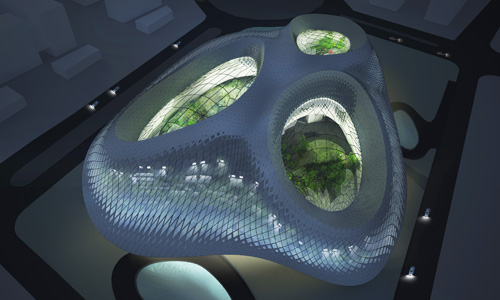
Beijing National Hotel

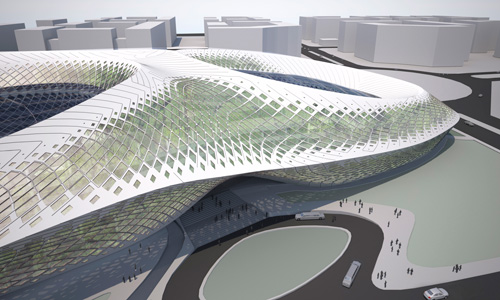
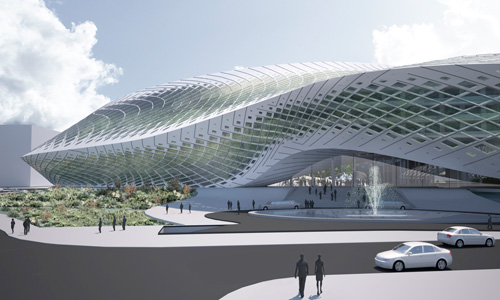
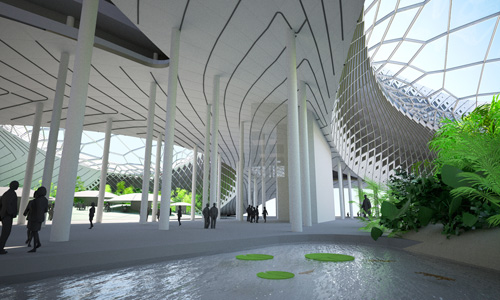
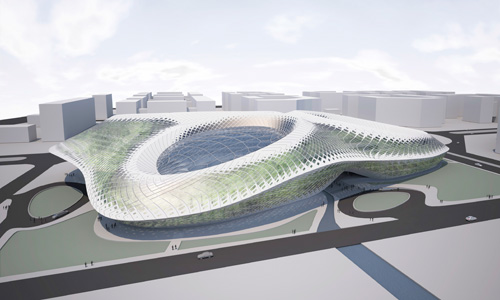
The creator, Emergent named this “Beijing National Hotel”. It will be the largest, the most abstract looking, and the most eco-friendly hotel in Beijing. Locate near the Beijing International Airport. Well, I never want to live at anywhere near an airport though, the aircraft is very disturbing when landing! Hope the creator had already taken this into consideration. So what else is so special about this hotel?


Beijing National Hotel

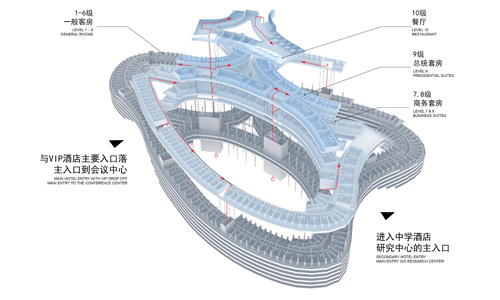
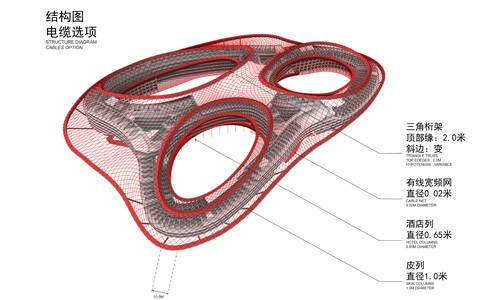
The building is 2.3 million square foot, composed by three volumetric rings, seems to signify the three different parts of this hotel.


Beijing National Hotel

It will include 1,500 rooms (Provides views of the city and the rainforest), international conference halls (Of course you know what is this used for), a 107,000 square foot indoor rainforest and a sky restaurant located at the highest level of the building (all direction of the view of the Beijing city).


Beijing National Hotel

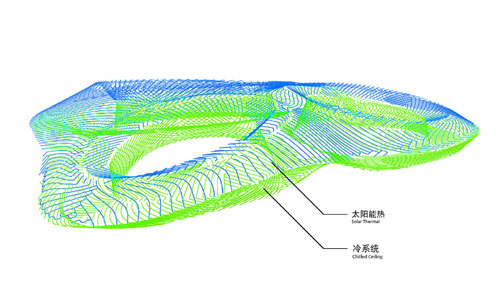
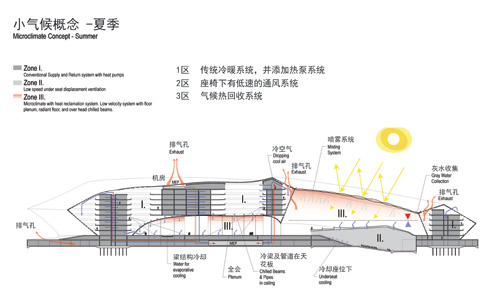
The building enclosed by a double skin system where the outer layer is a weather break and the inner layer is the weatherproof enclosure, which creates a thermal buffer zone.


Beijing National Hotel


Beijing National Hotel

Its outer layer is made from a lightweight cable-net structure with many windows. Therefore, it allows a certain amount of natural light penetrated into the interior of the building and the rainforest. Within this layer, it embedded with system of solar thermal pipes and grey water capture grooves which hybridizes the base diamond pattern with a sporadic weaving pattern.


Beijing National Hotel
Source: Emergent via Gizmodo

Friday, April 8, 2011

Google Earth 6.0.2.2074 Multilanguage Portable


Google Earth 6.0.2.2074 Multilanguage Portable | 33.8 MB

Google Earth combines satellite imagery, maps and the power of Google Search to put the world’s geographic information at your fingertips. Fly from space to your neighborhood. Type in an address and zoom right in. Search for schools, parks, restaurants, and hotels. Get driving directions. Tilt and rotate the view to see 3D terrain and buildings. Save and share your searches and favorites. Even add your own annotations.

Google Earth lets you do smooth sailing flybyes of the entire Earth. You can easily fly to any spot on the globe, by entering any associated data, like street addresses, place names or lat/long coordinates. There are overlays that put additional information on the map, like roads, international boundaries, terrain, 3D buildings, crime statistics, schools, stadiums, any number of interesting stuff. You can do Local searches in the program, with icons on the map and a display on the side showing your results.

You can leave notes, called "placemarks" all over the map, so you can remember where all sorts of places are. Searches and placemarks can be saved as bookmarks in "My Places". Everything can be output in an XML format called KML, that will allow the vast popularity of Google Maps to continue in Earth. You can also email a JPEG of the map, or send a KMZ file if you know the recipient has Earth installed.

Features:
- Sophisticated streaming technology delivers the data to you as you need it.
- Imagery and 3D data depict the entire earth - Terabytes of aerial and satellite imagery depict cities around the world in high-resolution detail.
- Local search lets you search for restaurants, hotels, and even driving directions. Results show in your 3D earth view. Easy to layer multiple searches, save results to folders, and share with others.
- Layers show parks, schools, hospitals, airports, retail, and more.
- Overlays – import site plans, design sketches and even scanned blueprints.
- Annotate the view with lines and polygons.
- Spreadsheet import - ingest up to 2,500 locations by address or lat/lon.
- KML – data exchange format let your share useful annotations.

Use it for:
- Planning a trip
- Getting driving directions
- Finding a house or apartment
- Finding a local business
- Exploring the world

Recommended configuration:
- Operating system: Windows 2000/ XP/ Vista
- CPU speed: Intel® Pentium® P4 2.4GHz+ or AMD 2400xp+
- System memory (RAM): 512MB
- 2GB hard-disk space
- 3D graphics card: 3D-capable video card with 32MB VRAM or greater
- 1280x1024, 32-bit true color screen
- Network speed: 128 kbps ("Broadband/Cable Internet")

Home Page - http://earth.google.com

Thursday, March 17, 2011

Tourists could see Southeast Asia on single visa

JAKARTA: Travellers could soon be able surf in Bali, shop in Singapore and eat spicy street food in Thailand before crossing into Cambodia and cruising the Mekong in Vietnam -- all on a single tourist visa.

The Association of Southeast Asian Nations (ASEAN) is working on a plan that would open the region to foreign tourists in the same way Europe's unified visa system has streamlined travel.

"You would just have to apply for one visa and you could then visit all the countries using that visa," said Eddy Krisneidi, an official at the Jakarta-based ASEAN Secretariat, which recently released its Tourism Strategic Plan for the next five years.

With attractions ranging from jungle-covered temples at Angkor Wat in Cambodia to five-star beach resorts in Bali, Southeast Asia is a region that tempts travellers from all walks of life.

ASEAN countries recorded more than 65 million foreign visitor arrivals in 2009. Malaysia led the field, followed by Thailand, Singapore, Indonesia, Vietnam, the Philippines, Cambodia, Laos, Myanmar and Brunei.

Analysts say visitor numbers could be boosted by slashing the time-consuming and confusing visa requirements for each of ASEAN's 10 countries, which range from vibrant developing democracies to isolated, military-dominated Myanmar.

While some allow foreigners to simply purchase visas on arrival, others require wads of paperwork, photos and up to a week to issue the required stamp.

"One of the major concerns of the industry, as well as visitors, is the difficulty of obtaining visas, a series of widely differing regulations and information needs for visas," ASEAN's strategic plan states.

It is a view shared by Stuart McDonald, who runs an online travel forum for Southeast Asia.

"One of the most common questions that we see on travelfish.org is people asking visa questions: What kind of visa can I get? How long is it valid for? What does it cost?," said the Australian who travels extensively in Asia.

"The rules change all the time and it introduces a level of uncertainty and confusion that the industry can do without."

The concept of a single visa has wide support among tourism bodies across Southeast Asia.

"It would definitely benefit all the countries in this region, especially Thailand," Tourism Authority of Thailand governor Suraphon Svetasreni said, noting that Thailand is a "good strategic location" for overland travelling as it acts as a bridge to other countries.

Svetasreni said it is only a matter of time until the region's visa system is liberalised.

"ASEAN will be considered as a single destination, so it makes sense to apply for a single visa to travel to any country in ASEAN," he said.

Despite its appeal, others are less optimistic that a single visa will become a reality anytime soon.

"Travel procedures have to be simplified but it is not going to be easy because each country may have their own foreign policy," Malaysian Association of Tour and Travel inbound tourism vice president Arul Das said.

ASEAN is yet to outline the cost or length of stay for its planned single tourist visa. But it acknowledges it could take several years to introduce.

"The establishment of such a visa will not likely occur in the next five years due to barriers of technology, political issues, concerns of sovereignty and security and the different visa systems in the member states," its strategic plan states.

The single visa is one of several initiatives being worked on by ASEAN to boost tourism in the region.

The organisation is also overseeing the creation of regional tourism standards which would apply to things such as accommodation, food and public toilets.

"There are already clear indications that major tour operators are now very much concerned with a wide range of standards in a destination," the plan states.

"Those destinations that are able to satisfy those increasingly high standards will have a distinct position of advantage."

-AFP/ac

Saturday, February 26, 2011

Top10 most liveable cities in the world

Auckland
CITY OF LIFESTYLE: Aucklanders enjoy living in one of the world's 10 best cities, the Economist survey confirms.
Vancouver topped the list of the world's most liveable cities for the fifth straight year, while Melbourne claimed second place from Vienna and Australian and Canadian cities dominated the list's top 10 spots.
Auckland was in 10th place.
In the annual survey by the Economist Intelligence Unit, the Canadian west coast city and 2010 Winter Olympics host scored 98 per cent on a combination of stability, health care, culture and environment, education, and infrastructure - a score unchanged from last year.
Vancouver has topped the list from 2007.
"Mid-sized cities in developed countries with relatively low population densities tend to score well by having all the cultural and infrastructural benefits on offer with fewer problems related to crime or congestion," said Jon Copestake, editor of the report, in a statement.
Pittsburgh was the top US city with 29th place - just ahead of Honolulu - while Los Angeles moved up three places to 44th and New York held onto the 56th spot.
London moved up one place to 53rd while Paris came in at number 16.
The top Asian city was Osaka at number 12, tying Geneva, Switzerland and beating out the Japanese capital of Tokyo, which came in at 18.
Hong Kong came in at 31 but Beijing, capital of the world's most populous nation and No 2 economy, straggled in at 72.
There was also little change at the bottom, with Harare, the capital of Zimbabwe, once again claiming the worst position with a rating of 37.5 percent, narrowing beating out the Bangladesh capital of Dhaka.
The Economist Intelligence Unit survey ranks cities based on 30 factors such as healthcare, culture and environment, and education and personal safety.
Following is a list of the top 10 most liveable cities as ranked by The Economist Intelligence Unit:
1. Vancouver, Canada
2. Melbourne, Australia
3. Vienna, Austria
4. Toronto, Canada
5. Calgary, Canada
6. Helsinki, Finland
7. Sydney, Australia
8. (equal) Perth, Australia
8. (equal) Adelaide, Australia
10. Auckland, New Zealand
The bottom 10 cities were:
1. Harare, Zimbabwe
2. Dhaka , Bangladesh
3. Port Moresby, Papua New Guinea
4. Lagos, Nigeria
5. Algiers , Algeria
6. Karachi, Pakistan
7. Douala, Cameroon
8. Tehran, Iran
9. Dakar, Senegal
10. Colombo, Sri Lanka
- Reuters

Thursday, January 27, 2011

'Little Italy' rises on Philippine hillside

MABINI, Philippines: On an isolated hillside in the Philippines, a tiny slice of Italy has risen from among the vegetable patches and coconut trees, the product of thousands of overseas workers.

Large stone houses - often with brand-new vehicles in their driveways - cover the district, even though the narrow streets can barely accommodate more than one car at a time.

This is a sharp contrast to the lifestyle in the 1980s, recalled district chairman Raymundo Magsino, 63.

"Back then, we depended on farming: vegetables, fruit and corn. We were the poorest district in the province. These were all just thatch huts," Magsino said, pointing to the pastel-coloured houses that dot the hilly area.

This new wealth comes from the remittances of residents - including entire families - who have gone to Italy to work, turning a district of subsistence farmers into a relatively prosperous community in a generation.

About 6,300 people from the town's total population of 47,000 have made the trip, said Aileen Constantino-Penas, programme director of a non-government organisation for migrant workers in Mabini.

The money sent home from Italy by Filipinos doing mostly domestic work and labouring has completely changed the face of Mabini town, located about 65 kilometres south of Manila.

Those who have left have brought touches of Italy back with them.

"The accents of their homes are no longer typical of Filipino homes," Constantino-Penas said.

Italian-style large terraces or wrap-around porches with marble balusters proliferate in Mabini, some with exteriors covered with artificial stone. Other houses look like mini-Pantheons, complete with Roman-style columns in front.

Traces of Italy can also be found inside the houses, even in the bathrooms. Bidets are common here even though they are unheard of elsewhere in the Philippines.

And when speaking among themselves, those from Italy sometimes use Italian words including the occasional "Mama Mia" exclamation, said Constantino-Penas, whose relatives are also among the workers in Italy.

Going abroad to seek higher-paying work is nothing unusual in the Philippines: nine million people, or about 10 per cent of the population, are currently labouring abroad.

They work as sailors, nurses, construction workers, musicians, maids and in dozens of other professions in almost every country in the world.

But the people of Mabini have found Italy to be especially welcoming.

District chairman Magsino said some people made the journey to Italy as early as 1977, at a time when this meant sneaking into the country illegally.

Working in Italy really caught on in the 1980s as word spread of the opportunities there, luring even more Mabini residents.

"People who have relatives there talked to (prospective) Italian employers and told them that (their relatives) will work for you so they fixed the papers to bring them in," Magsino said.

Luciana Hernandez, 81, said she was one of the pioneers of the exodus to Italy, having helped arrange for her daughter to go there to work in 1986, back when that meant sneaking into Italy from Austria or the former Yugoslavia.

"An agency took her by plane (to Europe). Then by speedboat, then they crossed the mountains on foot, hiding all the time," she recalled.

Once her daughter was established in Italy, she was able to petition for the rest of her siblings to go there, where they also obtained jobs, said Hernandez.

Eventually all but one of Hernandez's 10 children went off to work in Italy. Most of them are still there and have taken their own children with them, she said.

"When they first left, I cried every time I thought of them. But I am used to it now and these days, they can call very easily with these new phones," she said.

Life as a foreign worker in Italy is easier than in other countries, say those who have worked there. While tales of abused Filipino maids proliferate in many countries, Filipinos in Italy enjoy legal protection and many of them get along well with their hosts, they say.

"Italy is a better place, even if you are just a domestic helper. They treat you well and even give you insurance for hospitalisation," said Alona Solis, 39, who first went to Italy when she was 16 years old.

"They are not allowed to hurt you. You can complain about abuse, unlike some other countries."

Since she left for Italy in 1986, she has returned to the Philippines only twice: once in 2005 to get married and last December for a vacation that she is still enjoying. But she plans to go back to Italy soon.

"I am used to working there. My boss there already sees me as his child," she said.

Her husband also has a job in Italy and they share an apartment with her two young children, said Solis, who can speak Italian.

Solis can earn as much as 1,000 euros a month (1,350 dollars) as a domestic helper if she works overtime, far more than she could ever get in the Philippines as a high-school drop-out.

"If the educated people have trouble finding a job here, how much more the uneducated," she said.

Despite the wealth brought by the Italian ventures, officials concede that there are costs to having so many people from the community working outside the country.

Magsino, the district chairman, said family members left behind had become dependent on the remittances of their relatives.

"Many don't want to work in the farms anymore. They just play cards and go to cockfights," he lamented.

Constantino-Penas said her non-government organisation, Atikha, had been working to teach the overseas workers how to manage their money and to make sure their relatives at home didn't suffer the ill-effects of separation.

"There is a social cost of migration. Children left behind don't want to study. Their mindset is they should go abroad and not study. We see a lot of drop-outs, most of them among overseas workers' children," she said.

Her organisation is teaching children to stay in school, to save their money rather than spend it, while also helping their guardians learn how to budget and invest the money that is sent home from Italy.

Meanwhile, Mabini tourism officer Pacencia Casapao has struggled against the apathy lingering over the town in her effort to give it more touches of Italy.

"I've been asking for someone to come back and set up an Italian restaurant for tourists. But no one wants to do that," she said

- AFP/fa

Tuesday, October 19, 2010

Changi Airport welcomes 2 new airlines

SINGAPORE: Two new airlines will commence operations at Changi airport in the next two weeks.

Changi Airport Group said Philippines' Airphil Express and Malaysia's Berjaya Air are the sixth and seventh new airlines at the airport this year.

Singapore is Airphil's first international destination.

Starting October 27, Airphil will operate 14 weekly flights between Singapore and Manila from Changi's Terminal 2. From December 1, it will mount 14 weekly flights between Singapore and Cebu.

Airphil will join five other carriers currently flying to the Philippines.

Meanwhile, Berjaya will operate scheduled flights at the Budget terminal from November 1.

The services will start with 10 flights a week to Tioman in Malaysia.

From March next year after the monsoon season, the Malaysian carrier will increase frequencies to 28 weekly flights, 14 each to the resort islands of Tioman and Redang.

Both islands are new links for Changi.

-CNA/wk

Sunday, April 25, 2010

Marina Bay bridges open


The poser buzzing in many Singaporeans' minds was answered by Mr Mah Bow Tan yesterday when he opened the two landmark bridges across Marina Bay and revealed their names.
The Helix, at 280m long, was chosen for the spiral-shaped pedestrian bridge while the Bayfront Bridge, spanning 303m, was picked for the parallel bridge for vehicles.
About 2,000 people turned up at Marina Bay last night to witness the event. They were treated to a two-minute display of fireworks from the two bridges while taking in the panoramic view of the new downtown.
The crowd was also entertained by drummers and stilt walkers positioned on The Helix.
Mr Mah, the National Development Minister, declared the bridges open at about 8pm.
Vehicles can start using the Bayfront Bridge from 3pm today. The Youth Olympic Park, Singapore's first art park at the entrance of the bridges, was also opened yesterday.

Wednesday, March 24, 2010

Changi is World's best again


CHANGI Airport has bounced back from the third spot to become the World's Best Airport in an annual survey of travellers worldwide.
In the last Skytrax World Airport survey, Changi came in third. The last time it took top spot was in 2006.
Apart from being named Airport of the Year 2010, Changi Airport also picked up the titles for Best Leisure Amenities and Best Airport in Asia, said a statement from the Changi Airport Group on Wednesday.
The group's chief executive Lee Seow Hiang attributed Changi's success to 'the affirmation, encouragement and feedback' received from its stakeholders, 'including the millions of passengers and visitors' it serves every year. 'This has motivated us to continue to improve and innovate,' he added.
Changi Airport also picked up two other awards in the last three months, including its eighth Top Airport Worldwide by Wanderlust and its fifth Best Airport in Asia Pacific by DestinAsian.
Since its opening in 1981, Changi Airport has won more than 340 airport awards.

Wednesday, February 24, 2010

Bigger crowds expected at Natas fair

SINGAPORE: In a sign that those planning to travel are expecting this to be "a good year", more of them are expected to throng the Natas Travel Fair which opens on Friday.

The fair's organisers, the National Association of Travel Agents Singapore (Natas), expect 60,000 visitors and sales of S$50 million this year - 10 per cent more compared to the last Natas fair in August 2009.

In a sign that 165 exhibitors at the fair share the optimism, over 1,000 booths have been taken up.

"People are expecting it to be a good year and they are making plans to go for holiday ... it only slowed down last year because of H1N1, but once Singaporeans had a clearer picture of H1N1, they were travelling again," said Natas president Robert Khoo,

According to a recent survey by credit card issuer MasterCard, more Singaporeans are expected to travel within the first six months of this year compared to the second half.

Destinations in North Asia such as Japan and China are expected to continue to be the most popular.

Travel agencies like Chan Brothers are also expecting destinations in Europe to do well, with exotic destinations like Israel and Turkey to be in demand.

"Primarily because Singaporeans are a well-travelled lot ... they are looking for something off the beaten track," said Ms Jane Chang, Chan Brothers' assistant marketing communications manager.

Marina IR to open April 27


Marina Bay Sands, built beside Singapore's financial district, had been scheduled to open at the end of last year. The resort includes three 55-story hotel towers with 2,600 rooms and suites topped with the sky park. -- PHOTO: MARINA BAY SANDS


SINGAPORE'S second casino and integrated resort at Marina Bay Sands (MBS) will open its doors on April 27, announced its parent company Las Vegas Sands on Wednesday. This will be followed by the second phase opening on June 23.
The announcement comes barely less than a week after its rival Genting Singapore opened its Resorts World Sentosa casino to the Chinese New Year crowds on Feb 14.
In Phase One, some 963 hotel rooms, part of the shopping mall and convention centre, celebrity chef restaurants and other dining outlets, as well as the casino, will open on April 27, said MBS chief executive officer Thomas Arasi. But the opening schedule is subjected to 'construction proceeding as scheduled and being able to attain the necessary regulatory approvals,' he added.
Phase Two will be ready on June 23, which includes the Sands SkyPark, the Event Plaza along Marina Bay, the rest of the shops in the retail mall, and more dining options and nightlife. Mr Arasi said the IR will be marking Phase Two as part of its grand opening celebration.
Las Vegas Sands (LVS) chairman and chief executive officer Sheldon Adelson said in a statement: "Nearly four years ago, we embarked on a journey we believed would define the future of our company and at the same time change the face of tourism in Singapore and the South Asian region for decades to come. Now, as we approach the opening of Marina Bay Sands - one of the most remarkable leisure and business destinations ever created - it seems both of those ambitions are about to come true."
He added: 'Despite the challenging, and at times unprecedented economic conditions companies like ours recently faced, our dedication to completing this development never wavered, not even for a second. That determination defines this company as much as our ability to create and develop masterpieces such as Marina Bay Sands. We have no doubt the property will be a tremendous success, but how we got to this point will be every bit as important to the future prospects of our company.'

Monday, February 15, 2010

Southeast Asia's first Universal Studios theme park opens in Singapore

Click the image to open in full size.
World's tallest duelling roller-coasters, one seated and the other suspended, in Battlestar Galactica CYCLON vs HUMAN ride (2009 Resorts World Sentosa)


SINGAPORE: Southeast Asia's first Universal Studios theme park welcomed its first visitors on Sunday in Singapore.

It is part of the S$6.59-billion Resorts World Sentosa, which also opened Singapore's first casino in the afternoon.

Visitors to the park were transported into a world of Hollywood magic where celebrity culture and movies are celebrated.

Among the many highlights, visitors can travel back in time to the ancient world of Egypt, and the long lost land where dinosaurs come alive.

Fast forward to the future, the theme park features a sci-fi city where visitors can experience inter-galactic battles.

Of course, a theme park would not be complete without replicas of hit animated films. Universal Studios Singapore is also showcasing the fairytale world of Shriek, and the dense, tropical jungle of Madagascar.

First visitors to the park on Sunday created an air of buzz and excitement, with several adults admitting they feel like kids as the theme park worked its magic.

The roller-coaster rides created the most amount of hype, even though they were not operational during this phased-in opening.

"It would be better if we could get on the rides but I think it looks good so far," said a visitor. "We came to take a look first so next time we come, we know what to do."

"I was very amazed because it was quite similar to what I remember when I was in America and it brings back a lot of fond memories," said another visitor.

"We want to have a look and feel of the atmosphere of the place. My husband is quite afraid of the rides so this ticket is a much better buy than buying the full price."

Tickets were priced at S$10, and have been sold out for the eight-day sneak-peek period.

However, visitors can expect the full experience when Universal Studios Singapore re-opens, with all the rides and shows next month.

- CNA/yb

Friday, August 21, 2009

Singapore ranked second most expensive city in Asia, after Tokyo

SINGAPORE : Singapore has been ranked the second most expensive city in Asia, after Tokyo, with Hong Kong taking the third position.

In UBS' Prices and Earnings 2009 study released on Thursday, Singapore is ranked 24th globally, in a comparison of living costs in 73 cities around the world. The study was based on data collected between March and April this year.

It found Oslo, Zurich, Copenhagen, Geneva, Tokyo and New York to be the world's priciest cities based on a standardised basket of 122 goods and services. Mumbai, Delhi, Manila and Kuala Lumpur are cities with the lowest price levels.

The study said: "Asia is home to some of the world's priciest cities and nowhere is the spread between most expensive and cheapest more pronounced."

Employees in Copenhagen, Zurich, Geneva and New York have the highest gross wages, but Zurich and Geneva top the rankings in the international comparison of net wages.

In Asia, employees in Tokyo earn the highest wages, and are ranked 18th globally. Their salaries are about two times higher than those in Singapore, which came in at 40th globally. Manila, Jakarta and Mumbai are at the bottom of the table.

As for working hours, people work the longest hours in Asia and the Middle East, and the shortest in France. People work an average of 1,902 hours a year in the surveyed cities, but those in Asian and Middle Eastern cities work an average of 2,119 and 2,063 hours a year respectively.

Overall, Cairo employees work the longest hours, averaging 2,373 hours a year, followed by Seoul with 2,312 hours. In comparison, people in Lyon and Paris spend the least amount of time at work - putting in about 1,582 and 1,594 hours a year respectively.

- CNA/al

Tuesday, June 23, 2009

Faster ferries to Bintan


GETTING to Bintan just got faster and more comfortable. And those willing to pay a bit more will get airline-style business class treatment too.

Two new ferries will cut travelling time between Singapore and the Indonesian resort island by at least 15 minutes, making the trip from the Tanah Merah Ferry Terminal in 45 minutes.

The two ferries, which cost $31 million, are also equipped with the latest technology to stabilise them, making the ride smoother and more comfortable, even in the choppiest seas.

For passengers, the good news is that the ticket price for the ferry service remains the same. An adult who buys a Singapore-Bintan-Singapore ticket over the counter will pay $63.20 during peak period and $52.20 when it is off-peak.

Passengers who pony up an additional $36 for return will enjoy the ferries' new 'business class', which comes with bigger seats, complimentary drinks and access to an open deck for fresh air and that wind-in-your-hair experience.

'Emerald Class' passengers also get personalised immigration clearance in their own dedicated lounge and fuss-free luggage collection.

Programmes manager Amaranta Lim, 31, who came back here on the new ferry earlier this month, found the new vessel cleaner and more spacious and the ride, definitely smoother.

For $36 extra, she said she would certainly give the new business class a try. 'During school holidays, it can get quite noisy and tiring to queue up for immigration with all the families and kids. So, I don't mind paying a bit more for more comfort.'

The boats have been named Wan Sendari, after the wife of the legendary founder of Singapore Sang Nila Utama, and Wan Seri Beni, after the legendary Queen of the Riau Islands.

The improved ferry service is part of a 10-year masterplan to boost transport links to Bintan and part of the push to turn northern Bintan into a suburb for Singaporeans to live and play.